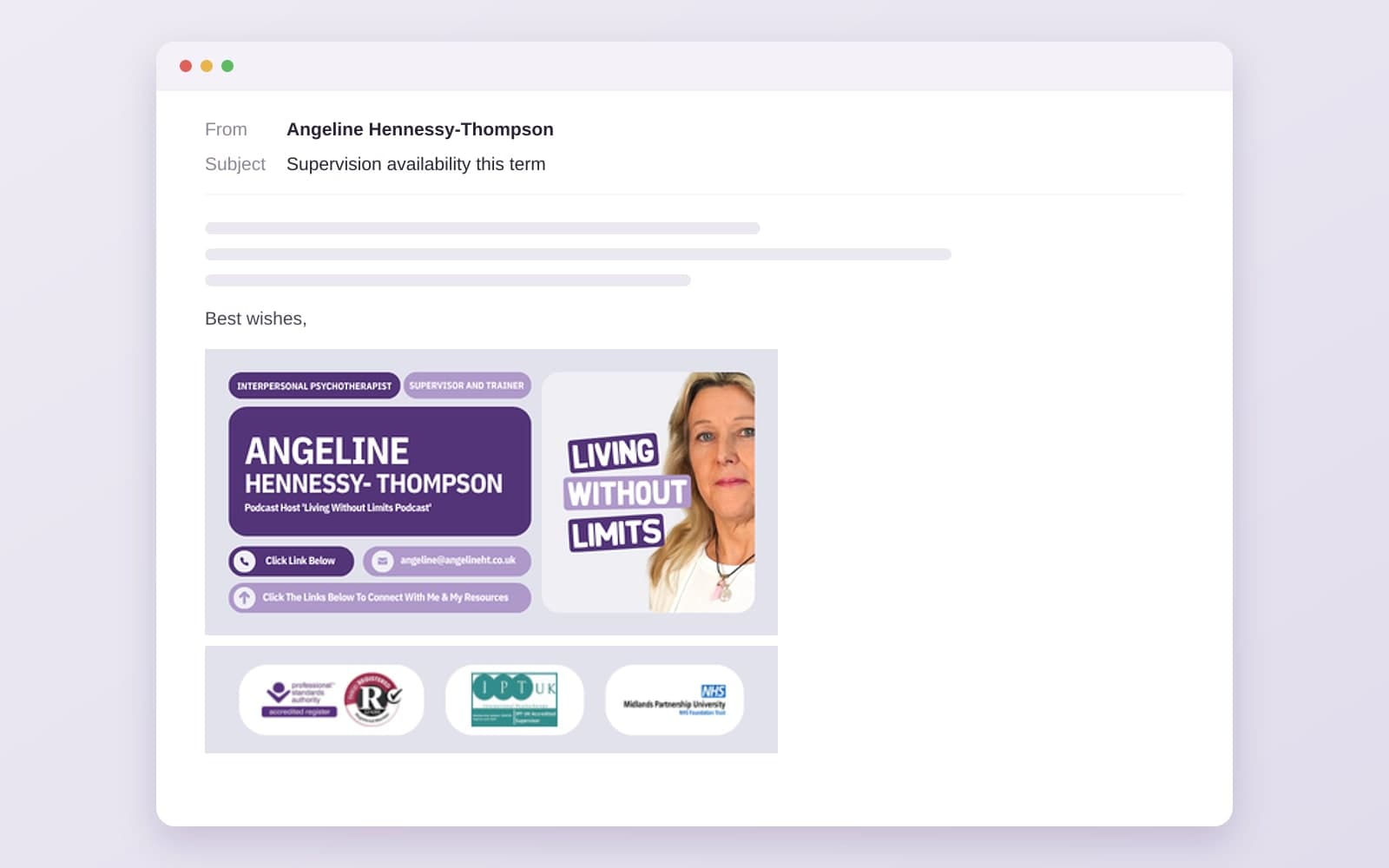
A therapist email signature should include your name, title, professional registration, practice name, phone, website and working hours, plus a short confidentiality notice and a crisis signposting line making clear email isn't monitored for emergencies. Build it as live HTML text rather than a single image, so it's readable, accessible and doesn't get blocked.
What should a therapist email signature include?
Think of it in three layers: who you are, how to reach you, and the boundaries around email.
Who you are
- —Full name, as it appears on your directory listings.
- —Title — 'Integrative Counsellor', 'Psychotherapist', 'Clinical Psychologist' — using only protected titles you hold.
- —Qualifications or membership level, e.g. 'MBACP (Accred)' or 'UKCP registered psychotherapist'.
- —Registration number where it adds reassurance, e.g. 'HCPC registered: PYL00000' or your BACP membership number. Clients can check these on public registers.
- —Practice name and logo.
How to reach you
- —Phone number (a business line, not your personal mobile).
- —Website, written short.
- —Working hours and typical response time: 'I reply to emails Monday to Thursday, usually within two working days.'
- —Location line: 'Leeds and online'.
- —Optionally, one link — booking page, latest workshop, podcast or a link hub. One clear action beats nine icons.
The boundaries
- —A crisis signposting line.
- —A short confidentiality notice.
- —If you trade as a limited company: the company's registered name, number, place of registration and registered office address, which the UK trading disclosure rules require on business correspondence.
What crisis line should a therapist put in an email signature?
Email is asynchronous and you aren't watching it around the clock, so it's good practice to say so — clearly and kindly, without alarming anyone. Keep it to one or two lines and use services that are well established. For example, for clients in England:
- —Example crisis line: 'This inbox isn't monitored outside working hours and isn't suitable for urgent support. If you need help now, call NHS 111 (select the mental health option), Samaritans free on 116 123, or 999 in an emergency.'
Adjust the services for where your clients live — NHS 24 on 111 in Scotland, for example — and check that the numbers and options are still current once a year. Set the line in the same size as the rest of the signature; tiny grey text defeats the point.
Do therapists need a confidentiality notice in their email signature?
A confidentiality notice doesn't make email secure, and it won't override data protection law, but it does tell an accidental recipient what to do, and it reminds clients that email has limits. Keep it short and human rather than a paragraph of legalese:
- —'This email is confidential and intended only for the person it's addressed to. If you've received it by mistake, please let me know and delete it.'
- —'Email isn't a fully secure way to share sensitive information. Please keep messages to practical matters and we can talk about anything more personal in session.'
- —'I handle your information in line with UK GDPR. You can read my privacy notice at fernbanktherapy.co.uk/privacy.'
Linking to your privacy notice is more useful than reproducing it. And whatever the signature says, avoid putting clinical detail in email — that's a practice decision, not a design one.
Therapist email signature examples
Three layouts we use as starting points, from simplest to fullest. Names and numbers are placeholders.
| Element | Example 1: Minimal counsellor | Example 2: Psychologist | Example 3: Practice owner and trainer |
|---|---|---|---|
| Name | Hannah Clarke | Dr Sam Patel | Jo Reeves |
| Title | Integrative Counsellor, MBACP | Clinical Psychologist | EMDR Consultant & Trainer |
| Registration | BACP membership no. 000000 | HCPC registered: PYL00000 | Accredited EMDR Consultant; UKCP registered |
| Practice | Fernbank Therapy | Patel Psychology | Riverstone Therapy & Training |
| Contact | 07000 000000 · fernbanktherapy.co.uk | 0117 000 0000 · patelpsychology.co.uk | riverstonetherapy.co.uk |
| Hours | Replies Mon–Thu within two working days | Clinic days Tue, Wed, Fri | Office hours Mon–Fri, 9am–4pm |
| Call to action | None | Book an initial consultation | Next EMDR training: view dates |
| Crisis line | Yes | Yes | Yes |
| Confidentiality | One sentence | One sentence plus privacy link | One sentence plus privacy link |
| Company details | Not needed (sole trader) | Not needed (sole trader) | Riverstone Therapy Ltd, registered in England & Wales no. 00000000, registered office address |
For a real example, we designed Angeline Hennessy-Thompson's signature to carry her credentials, her Living Without Limits podcast and her book, consolidating nine destinations into a single Linktree call to action across three versions as her work grew. Read the Angeline Hennessy-Thompson case study →
Should a therapist email signature be HTML or an image?
Build the signature as HTML — real text with small images for the logo and any credential badges — rather than one flattened image. Here's why:
| HTML text signature | Single image signature | |
|---|---|---|
| Shows when images are blocked | Yes — text still appears | No — recipient sees a blank box or attachment |
| Screen readers | Readable | Only via alt text, if set |
| Clickable phone and links | Yes | Only one link for the whole image |
| Copy and paste your number | Yes | No |
| Spam filters | Generally fine | Image-only emails can look suspicious |
| Dark mode | Text adapts | Can look odd with a white box around it |
| Consistent look everywhere | Slight variation between email apps | Pixel-identical |
The hybrid approach works best: a small logo or portrait (around 80–120 px tall, saved at twice that size for sharp retina display) and a credential strip as images, with every word that matters — name, title, number, phone, crisis line — as text. Host images on your own website rather than attaching them, so they don't show as attachments on every reply.
Setting it up
- —Gmail: Settings > See all settings > General > Signature. Paste in a signature copied from a rendered HTML page, not from a Word document.
- —Outlook: Settings > Account > Signatures. Check the mobile app separately — it often uses its own plain signature.
- —Apple Mail: Settings > Signatures; untick 'Always match my default message font' to keep your styling.
- —Send a test to Gmail, Outlook and an iPhone, in light and dark mode, before using it with clients.
How do you make an email signature accessible?
- —Use text sizes of at least 12–14 px for everything people need to read, including the crisis line.
- —Keep text contrast at 4.5:1 or above. Pale grey disclaimers usually fail.
- —Add alt text to every image: 'Fernbank Therapy logo', not 'image001.png'.
- —Use descriptive link text: 'Book a free call', not 'click here'.
- —Limit it to one or two fonts with web-safe fallbacks such as Arial or Georgia — custom fonts won't load in most email apps.
- —Keep the whole signature to around six to eight lines plus the notices. Long signatures make email threads hard to read.
An email signature is a boundary as much as a business card. It tells people who you are, when you'll reply, and where to go if they can't wait.
Adam Watters, Founder, Psyche Creative
Common email signature mistakes therapists make
- —A personal mobile number that clients then text at all hours.
- —Inspirational quotes — they can land badly with someone in a difficult moment.
- —Nine social icons for accounts you rarely use.
- —Credentials as tiny unreadable logos with no text equivalent.
- —Professional body logos used without checking that body's logo guidelines.
- —A different signature on your phone than on your laptop.
Your signature should match the rest of your brand — same colours, fonts and logo versions. If you don't have those written down yet: Read: brand style guide for therapists →
We design HTML email signatures for therapists and trainers, with large, small and transparent exports and a copy-and-paste install guide. See our Graphic Design service →
Frequently asked questions
What should a therapist put in their email signature?
Your name, title, professional registration, practice name, phone, website and working hours, plus a short confidentiality notice and a line explaining where to get urgent help, since email isn't monitored around the clock.
Should I include my registration number in my email signature?
It's a good idea where it reassures clients — for example an HCPC registration number or BACP membership number — because people can check it on the public register.
What crisis signposting should go in a therapy email signature?
A brief line saying the inbox isn't for urgent support, followed by established services such as NHS 111 (mental health option, in England), Samaritans on 116 123 and 999 in an emergency. Adjust for the nations your clients live in.
Is an image or HTML email signature better?
HTML is better. Real text stays readable when images are blocked, works with screen readers and makes phone numbers and links clickable; use small images only for your logo and badges.
Do limited company therapy practices need extra details in emails?
Yes. UK trading disclosure rules require a limited company's registered name, registered number, place of registration and registered office address on business correspondence, which includes email.
Adam works with UK therapy practices, EMDR trainers and mental health organisations on websites, social media and digital campaigns. He started Psyche Creative to give clinicians a marketing partner who understands the sector — and won't compromise on professional standards to get results.