A good pull up banner says who you are and what you offer in the top third, where people see it over a crowd, and uses no more than 15 to 25 words in total. The standard UK roller banner is 850 x 2000 mm; design at 300dpi at a smaller scale or 100 to 150dpi at full size, keep the bottom 100 to 150mm free of anything important, and expect to pay roughly £50 to £150 for a good-quality banner with stand.
When does a therapist need a pull up banner?
Most solo practitioners never need one. They earn their keep for therapy training providers exhibiting at conferences, practitioners who run workshops or CPD events, group practices attending local wellbeing fairs or university welcome weeks, and anyone who speaks regularly at events and wants their name visible behind them. If you are going to be standing at a table in a room full of other stands, a banner is the difference between being noticed and being walked past.
If you run training, CPD or accreditation, our page for trainers covers how we support cohort-based providers with events, video and recruitment. See how we work with trainers →
What size is a standard pull up banner?
The standard UK roller banner is 850mm wide by 2000mm tall, and it is what most event organisers assume when they allocate stand space. Wider options exist, but check your stand dimensions before ordering anything larger.
| Size (W x H) | Typical use | Notes |
|---|---|---|
| 800 x 2000 mm | Compact or budget banners | Slightly narrower; check the template matches the exact cassette |
| 850 x 2000 mm | The UK standard | Fits almost any stand; easiest to find replacement graphics for |
| 1000 x 2000 mm | A bit more presence on a standard stand | Good if you have a wider table |
| 1200 x 2000 mm | Larger stands, backdrops for speakers | Heavier to carry |
| 1500 x 2000 mm | Shell schemes, photo backdrops | Often used in pairs; check your space |
| 850 x 2200 mm | Taller version for big halls | Some stands are adjustable; check before designing |
Two details catch people out. First, the bottom 100 to 150mm (sometimes more) of the graphic usually disappears into the base cassette or sits behind the table, so nothing important can go there. Second, some printers want bleed on all four sides and some want extra length at the top or bottom for fixing. Download the specific template from your printer and work from that.
Our free cheat sheet lists roller banner sizes alongside leaflet, poster and business card dimensions, with bleed and safe zones. See the UK print design sizes cheat sheet →
What is the top-third rule for roller banners?
At a busy event, people see the top of your banner over the heads of the crowd and over the table. The lower part is often hidden by people, chairs, the tablecloth or you. So the top third of the banner, roughly the top 650mm on a 2000mm banner, carries everything someone must take in at a glance: your logo or name and a short line saying what you do.
- —Top third (eye level and above): logo or name, plus one short headline. This is the part visible across the room.
- —Middle third: one supporting line, a few key points or a single strong image. Read by people who have slowed down.
- —Bottom third: website address and, if useful, a QR code at a height people can reach with a phone. Remember the lowest 100 to 150mm may be hidden.
A practical test: print your design at A4, stand it on a shelf at the far end of a room and walk towards it. If you cannot tell who it is for and what it offers from five metres away, it is not working yet.
How many words should a pull up banner have?
As few as possible. We aim for 15 to 25 words in total, including the headline. People walking past a stand give it a second or two. Your banner's job is to make the right people stop. Once they have stopped, you, your leaflets and your conversation do the rest.
| Element | Example for an EMDR trainer | Example for a counselling practice |
|---|---|---|
| Name or logo | [Your training brand] | [Your practice name] |
| Headline | EMDR Europe accredited training | Counselling for adults and young people |
| Supporting line | Small cohorts. Experienced trainers. Ongoing consultation. | Online and in person across [town] |
| Call to action | Next cohorts: [website]/dates | Free 15-minute call: [website] |
What to leave off: lists of every modality, long paragraphs about your approach, full addresses, multiple phone numbers, and social media icons for every platform. If you really want social handles, pick the one you are most active on.
How big should text be on a roller banner?
A common rule of thumb for signage is roughly 25mm of letter height for every three metres of viewing distance, give or take, depending on the typeface and contrast. On a standard 850mm banner that translates to:
| Element | Approximate cap height | Readable from roughly |
|---|---|---|
| Headline | 80 to 120 mm | 8 to 12 metres |
| Supporting line | 40 to 60 mm | 4 to 6 metres |
| Web address | 30 to 40 mm | 3 to 4 metres |
| Small print (if any) | 15 to 20 mm minimum | Close range only |
Use a typeface with open, clear letterforms at heavier weights. Fonts that look elegant at 16px on screen, especially thin or light weights, often disappear on a banner under exhibition-hall lighting. Montserrat SemiBold, DM Sans Bold, Nunito Sans Bold and Source Serif 4 Semibold all hold up well at distance.
Contrast and colour
Events are visually loud. Strong contrast between text and background helps you stay legible: aim well above the 4.5:1 WCAG ratio you would use for body text on a website, as distance and lighting reduce effective contrast. A deep brand colour such as a navy #1F3A5F or forest green #2F4F3E with off-white text reads clearly from across a room, and still feels calm. Pale pastels with white text almost never do.
Pull up banner design mistakes we see most
- —Too much text. If it reads like a leaflet, nobody will read it.
- —Important content in the bottom 150mm, hidden by the cassette or the table.
- —Low-resolution logos or photos that look fine on screen and blurry at two metres tall.
- —Thin fonts and pale colours that vanish under hall lighting.
- —A QR code at ankle height, or so small it will not scan from arm's length.
- —Stock images that feel clichéd or distressing, such as head-in-hands photographs. A calm, abstract design or a real photo of you or your training room is almost always better.
- —Event-specific details, like a date or a price, on a banner you want to reuse for years.
What file should you send for a roller banner?
Large-format files are usually set up differently from leaflets. Follow your printer's template, but these are typical:
- —PDF, CMYK, fonts embedded or outlined.
- —Either full size at 100 to 150dpi or a quarter-scale file (for example 212.5 x 500 mm) at 300 to 400dpi. Both give enough detail for a banner viewed from a distance; ask your printer which they prefer.
- —Vector logos (SVG, EPS or PDF) wherever possible, so they stay crisp at any size.
- —Bleed as specified, often 5 to 10mm for large format rather than the 3mm used on leaflets.
- —Photographs large enough for the final size; a phone photo can work if it is sharp and uncropped, but check it at 100% zoom.
What materials are roller banners printed on?
| Material | Feel | Pros | Cons |
|---|---|---|---|
| Standard PVC (around 400 to 440 micron) | Smooth, slightly shiny | Cheap, durable, vivid colour | Can reflect light; can curl at the edges over time |
| Anti-curl polyester / PET film | Matt or satin, flat | Stays flat, less glare, looks more premium | A little more expensive |
| Fabric (tension or roller) | Soft, textile | Very low glare, washable, lightweight, can feel warmer | Higher cost, colours can be slightly softer |
For therapy and training brands, we usually recommend a matt anti-curl material. It photographs better (your banner will end up in other people's event photos and LinkedIn posts), reflects less light, and has a calmer feel than high-gloss PVC.
How much does a pull up banner cost in the UK?
Prices change and vary by supplier, so treat these as rough ranges from our experience at the time of writing (October 2026), including printing and a stand.
- —Economy banner with basic stand: roughly £40 to £70. Fine for occasional use; the stands can be flimsy.
- —Mid-range banner with a sturdier stand and anti-curl material: roughly £70 to £150. The sweet spot for most practices and trainers.
- —Premium stand, fabric or replaceable cassette: roughly £150 to £300. Worth it if you exhibit several times a year.
- —Replacement graphic for an existing stand: often cheaper than a whole new banner, if the stand is a standard size.
Design is separate. If you already have a brand style guide, a banner design is usually a quick job. If not, it is worth sorting your brand basics first so that banner, leaflets and website all look like the same organisation.
A roller banner isn't there to explain your training. It's there to make the right person stop walking so you can have a conversation.
Adam Watters, Founder, Psyche Creative
Pull up banner checklist
- —Name and one-line offer visible in the top third.
- —15 to 25 words in total.
- —Headline readable from at least 8 metres.
- —Nothing important in the bottom 150mm.
- —Strong contrast, heavier font weights.
- —No dates or prices, unless the banner is for one event.
- —QR code at chest height, at least 80 to 100mm square, tested from arm's length.
- —Built from the printer's template, CMYK, with vector logo.
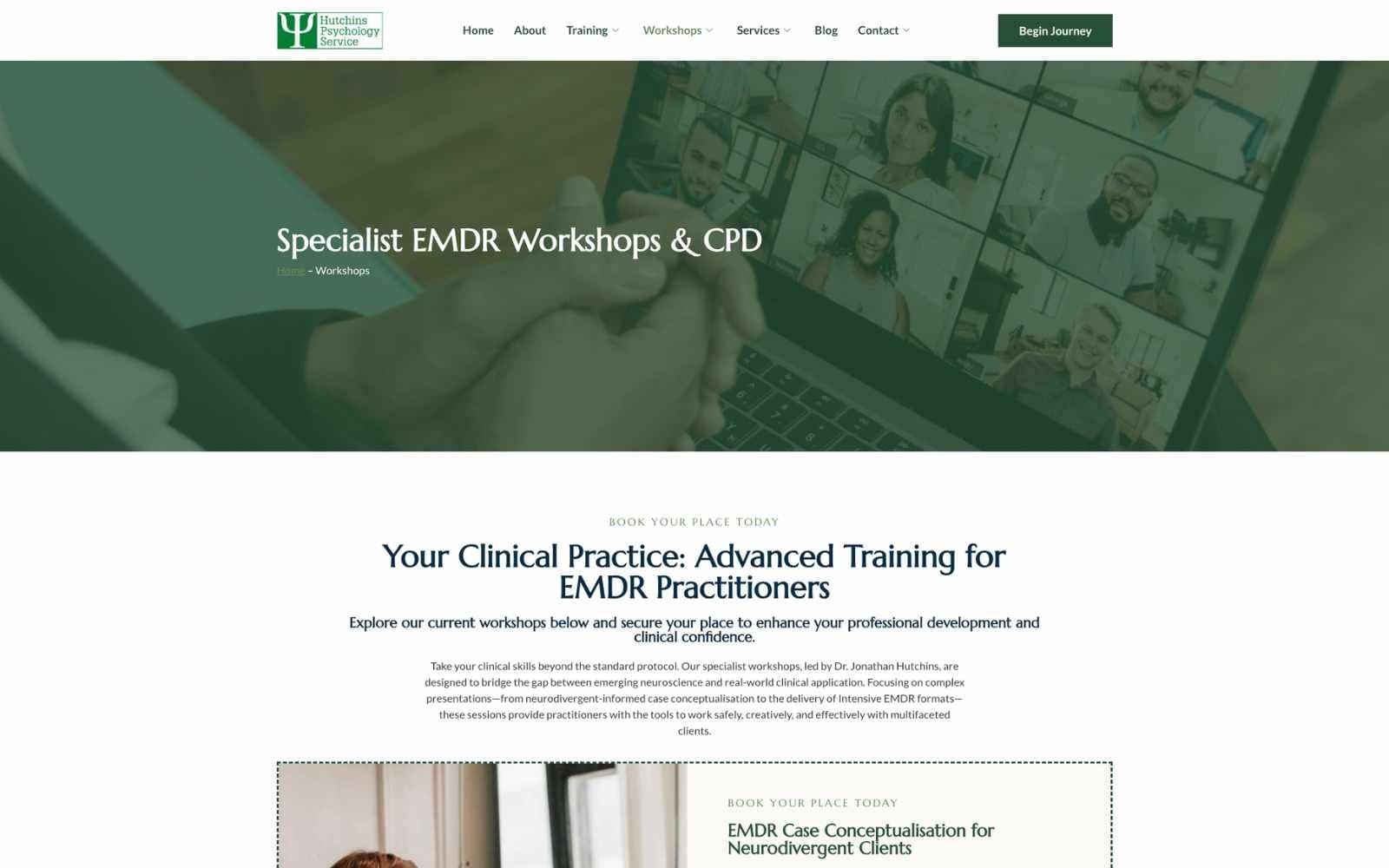
Hutchins Psychology, led by an EMDR Europe Accredited Trainer, is a good example of a training provider whose website and branding need to work together for therapy, training and supervision audiences. Read the Hutchins Psychology case study →
We design pull up banners, event materials and CPD print sets for therapists and training providers, with print-ready files built to your printer's template. See our Graphic Design service →
Frequently asked questions
What is the standard size of a pull up banner in the UK?
The standard UK pull up banner is 850mm wide by 2000mm tall. Other common widths are 800, 1000, 1200 and 1500mm, but always design from your printer's template.
How much text should go on a roller banner?
Aim for 15 to 25 words in total. Put your name and a short headline in the top third, one supporting line in the middle, and your web address lower down.
What resolution should a pull up banner be?
Typically either full size at 100 to 150dpi or a quarter-scale file at 300 to 400dpi. Use vector logos and check your printer's preferred setup.
How much does a pull up banner cost?
In the UK, a good-quality banner with stand typically costs roughly £70 to £150 at the time of writing, with economy options from around £40 and premium stands above £150. Design is usually charged separately.
Why does the bottom of a roller banner need to stay clear?
The bottom 100 to 150mm or so usually sits inside the base cassette or behind a table, so anything placed there may be hidden. Keep text and logos well above it.
Adam works with UK therapy practices, EMDR trainers and mental health organisations on websites, social media and digital campaigns. He started Psyche Creative to give clinicians a marketing partner who understands the sector — and won't compromise on professional standards to get results.