The best Instagram Reel ideas for therapists are simple and calm: talking-to-camera answers to common questions, short psychoeducation explainers, a tour of your therapy room, and gentle myth-busting. Film vertically on your phone in natural light, keep most Reels under 60 seconds, and always add accurate captions.
Why should therapists make Instagram Reels?
Video lets a potential client hear your voice, see your face and get a sense of what you're like in the room before they ever get in touch. That matters in therapy more than almost anywhere else, because the relationship is the work. A 40-second clip of you explaining what happens in a first session can do more to lower the barrier to booking than a page of website copy.
Reels are also how Instagram currently shows content to people who don't follow you yet. You don't need them to go viral. A Reel that 300 people in your area watch all the way through is far more useful than one that 30,000 strangers scroll past.
Which Reel formats suit therapists?
| Format | What it is | Best for | Length |
|---|---|---|---|
| Talking to camera | You, framed chest-up, answering one question | Building trust and familiarity | 30 to 60 seconds |
| Voiceover with B-roll | Your voice over gentle footage of the room, a walk, a cup of tea | Therapists who'd rather not be on camera every time | 20 to 45 seconds |
| Text on screen | Calm footage with a few lines of on-screen text | Short reassurance and reflections | 7 to 15 seconds |
| Explainer with props | A whiteboard, notebook or simple diagram | Psychoeducation | 45 to 90 seconds |
| Clip from a longer video | A highlight from a talk, webinar or podcast | Trainers and practices with existing video | 30 to 90 seconds |
30 Instagram Reel ideas for therapists
Answering the questions clients ask (8)
- —1. 'What actually happens in a first therapy session?'
- —2. 'How do I know if I need therapy?' (Answer: you don't need to be sure.)
- —3. 'What should I talk about if I don't know where to start?'
- —4. 'How long does therapy take?'
- —5. 'Is online therapy as good as in person?'
- —6. 'What's the difference between a counsellor and a psychologist?'
- —7. 'What if I cry?' or 'What if I don't?'
- —8. 'Can I bring my partner or a friend to the first appointment?'
Psychoeducation explainers (8)
- —9. The window of tolerance, drawn on a notebook in 60 seconds.
- —10. What EMDR is and what the bilateral stimulation is for.
- —11. Why anxiety shows up in your stomach.
- —12. Fight, flight, freeze and fawn, one at a time.
- —13. A grounding exercise you can do at your desk, demonstrated slowly.
- —14. The CBT hot cross bun, with a real-world example.
- —15. Why we replay conversations at night.
- —16. What 'regulation' means, without jargon.
Myth-busting, gently (5)
- —17. 'Therapy isn't just lying on a couch talking about your childhood.'
- —18. 'Hypnotherapy won't make you do anything you don't want to.'
- —19. 'You don't have to have a diagnosis to see a therapist.'
- —20. 'Going to therapy doesn't mean you've failed.'
- —21. 'Your therapist won't judge you for what you say.'
Behind the practice (5)
- —22. A slow, quiet tour of your therapy room, voiceover explaining what to expect on arrival.
- —23. The walk from the nearest station or car park to your door.
- —24. What happens after you send an enquiry, step by step.
- —25. Why you chose your modality, in your own words.
- —26. Setting up the room before a day of sessions (no clients, no names, no diaries on screen).
Seasonal and reflective (4)
- —27. A calm 10-second Reel for a hard week: rain on a window and one line of on-screen text.
- —28. An awareness day message, with signposting on screen and in the caption.
- —29. A September back-to-school or back-to-work anxiety explainer.
- —30. A December Reel on grief and loneliness at Christmas, with a content warning.
Need more ideas beyond video? Our list of 100 post ideas is grouped by content pillar, and many of them work as Reels too. Read 100 social media post ideas for therapists →
What equipment do therapists need to film Reels?
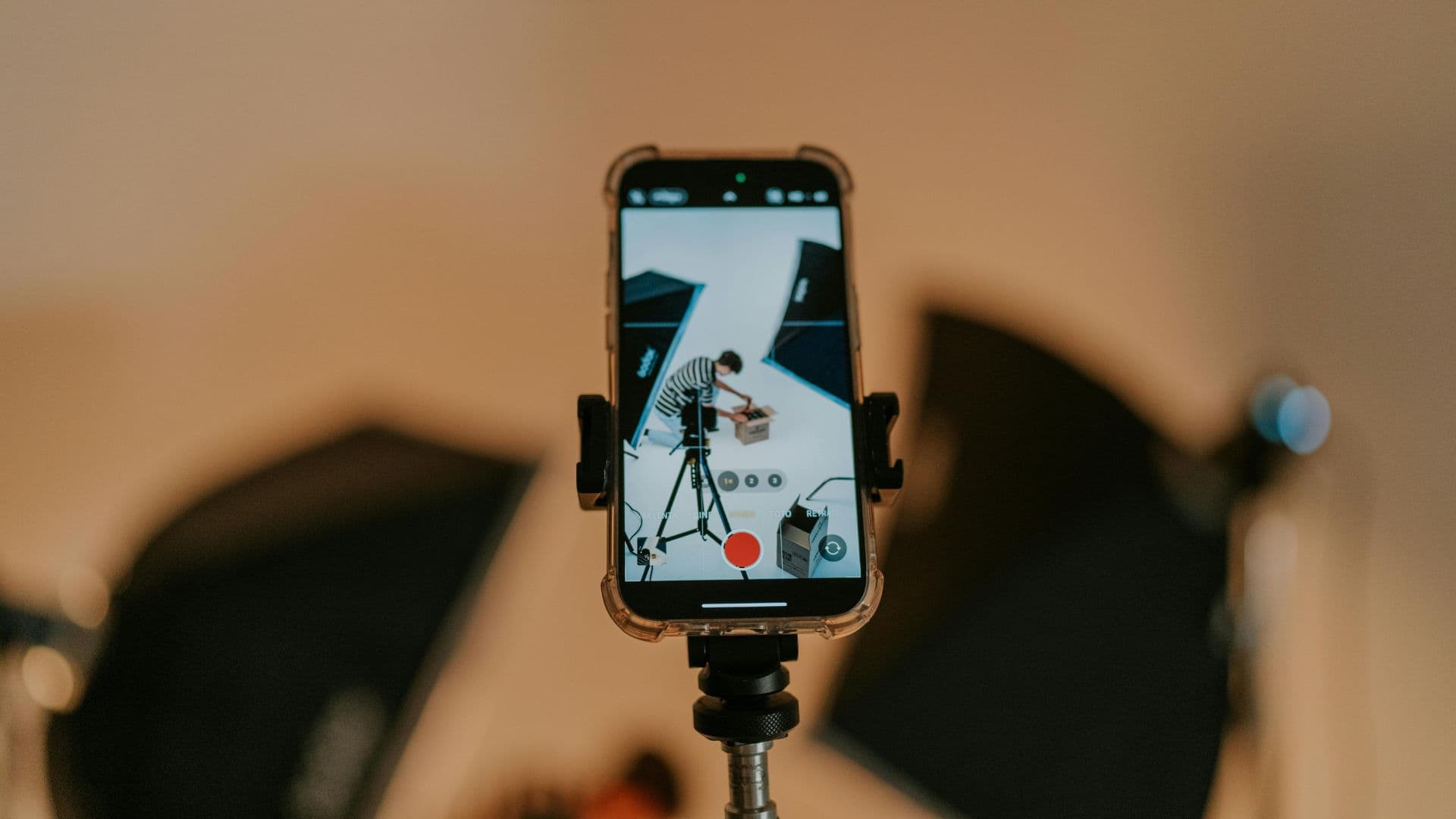
A recent smartphone is enough. Spend your money on sound before anything else, because people will forgive slightly soft video but they won't sit through muffled or echoey audio.
| Item | Why | Rough cost |
|---|---|---|
| Your phone's main (rear) camera | Better quality than the selfie camera | Already owned |
| A clip-on or wireless lavalier mic | Clear voice, less room echo | £20 to £150 |
| A small tripod or phone stand | Steady, eye-level framing | £15 to £40 |
| Window light (or a small LED panel) | Soft, even light on your face | Free to £50 |
| A soft furnishing in the room | Cushions, rugs and curtains reduce echo | Free |
Filming setup checklist
- —Shoot vertically in 9:16 at 1080 x 1920 pixels.
- —Face a window so the light falls on your face; avoid sitting with a bright window behind you.
- —Set the phone at eye level, about an arm's length or a little more away, framed from mid-chest up.
- —Keep key text and your face away from the top and bottom of the frame, where Instagram's interface overlays the video.
- —Check the background for anything confidential: diaries, client files, names on a whiteboard, a reflection in a mirror.
- —Record three or four takes, pick the best, and don't aim for perfect. Natural is more trustworthy.
- —Say the point of the video in the first three seconds: 'Here's what happens in a first therapy session.'
At the time of writing (October 2026), Instagram allows Reels up to three minutes long, but for most therapy content 30 to 60 seconds is the sweet spot. If you have more to say, make a series.
How should therapists caption Reels for accessibility?
Always add captions. Many people watch with the sound off, and for Deaf and hard-of-hearing viewers captions are the difference between being able to watch and not. Good captions also help people who process information better by reading, and they help Instagram understand what your video is about.
- —Use Instagram's auto-captions or your editing app's caption tool, then check every word. Auto-captions often mangle clinical terms like 'EMDR', 'dissociation' or a modality name.
- —Burned-in captions (added in an editing app) look consistent everywhere, including when the Reel is shared to Stories or other platforms.
- —Choose a clear sans-serif font, at least the size of comfortable phone text, with a solid or semi-opaque background behind it so it meets 4.5:1 contrast on any footage.
- —Keep captions to one or two short lines at a time and place them in the middle third of the screen, clear of Instagram's buttons.
- —Avoid flashing, rapidly changing word-by-word captions. They're harder to read and can be uncomfortable for some viewers.
- —Write a caption under the Reel too, summarising the video with your keywords, specialism and town.
- —Add a content warning on screen in the first second if the topic is sensitive.
The Reels that bring therapists enquiries are rarely clever. They're a calm person explaining one thing clearly, with good sound and accurate captions.
Adam Watters, Founder, Psyche Creative
How often should a therapist post Reels?
One a week is a good, sustainable target for a solo practitioner. Batch-filming helps: set aside one morning a month, film four or five short answers to common questions, and edit them over the following weeks. For Redland Psychology Services we produce two videos and a static post every week across Instagram and YouTube, so the clinicians can stay focused on client work.
See how a regular video rhythm works in practice for a psychology service. Read the Redland Psychology Services case study →
If editing is the part that stops you, our guide explains what therapists can do themselves and what's worth handing over. Read video editing for therapists →
We edit therapists' raw footage into captioned, on-brand Reels, and can film a month of content with you on a recording day. See our Video Production service →
Frequently asked questions
What should a therapist post on Instagram Reels?
Short, calm videos answering common client questions, explaining one psychological idea, gently busting myths, or showing your therapy room. None of it requires trends, dancing or music.
How long should a therapist's Reel be?
Most work best at 30 to 60 seconds. At the time of writing (October 2026) Instagram allows Reels up to three minutes, but shorter videos are easier to watch to the end.
Do I have to show my face in Reels?
No. Voiceover over calm footage of your room, a walk or simple objects works well. Showing your face does build familiarity faster, so it's worth trying when you feel ready.
Are Instagram's auto-captions good enough?
They're a good start, but always review them. Auto-captions often get clinical terms and names wrong, and inaccurate captions undermine accessibility and credibility.
What's the best size for Instagram Reels?
Film vertically at 9:16, 1080 x 1920 pixels. Keep text and your face away from the very top and bottom of the frame, where Instagram's buttons and captions sit.
Adam works with UK therapy practices, EMDR trainers and mental health organisations on websites, social media and digital campaigns. He started Psyche Creative to give clinicians a marketing partner who understands the sector — and won't compromise on professional standards to get results.